


President Donald Trump said the US had captured Venezuela’s strongman leader Nicolás Maduro and flown him out of the country and said Washington would run the country until a transition could be put in place.
In a Truth Social post on Saturday, Trump announced Maduro’s seizure, which marked the first time the US had captured a Latin American leader in more than three decades, and confirmed US strikes on Venezuela.
“The United States of America has successfully carried out a large scale strike against Venezuela and its leader, President Nicolás Maduro, who has been, along with his wife, captured and flown out of the Country,” he wrote.
“We are going to run the country until such time as we can do a safe proper and judicious transition,” Trump said in a later press conference.
He added that he was “not afraid of boots on the ground” in Venezuela, declining to rule out an American military presence in the country.
“We are going to have a presence in Venezuela as it pertains to oil,” Trump said, adding that the US would be “reimbursed for everything that we spend”.
Trump also said: “We’re going to have our very large United States oil companies, the biggest anywhere in the world, go in, spend billions of dollars, fix the badly broken . . . oil infrastructure, and start making money for the country.”
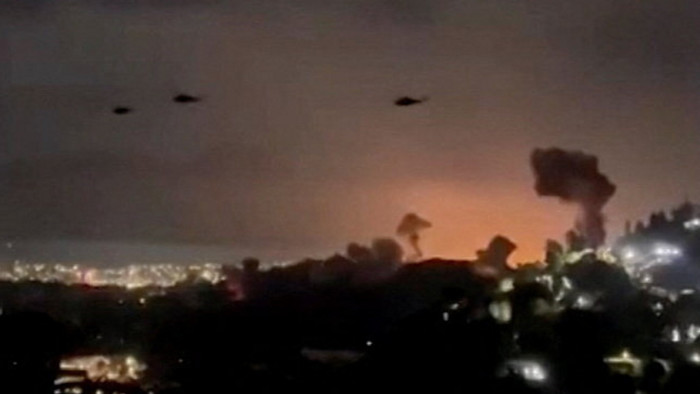
The US later said that 150 aircraft were involved in the operation, which struck Caracas multiple times early on Saturday morning. Trump said that many of the lights in the capital had been “turned off due to a certain expertise that we have”.
The seizure of Maduro was carried out by Delta Force, an elite US special forces unit, and was supported by intelligence provided by the CIA, according to a person familiar with the matter.
The person added that the CIA has had a small team on the ground in the country since August that could provide “extraordinary insight” into Maduro’s movements which enabled US special forces to seize him in an overnight raid.
The US president told Fox News the operation was initially planned to take place four days ago but was called off because of poor weather. He added that Maduro had been in a “highly guarded” facility and no US personnel or aircraft were lost in the operation.
Trump said that Maduro and his wife had been taken out of Venezuela via helicopter and were being transported to New York, adding that the move “sends a signal” that the US is “not going to be pushed around”. He also posted a picture of what appeared to be a handcuffed and blindfolded Maduro “on board the USS Iwo Jima”.
US attorney-general Pam Bondi wrote on X that Maduro and his wife had been indicted in a federal court in New York and were facing charges including narco-terrorism conspiracy.
“They will soon face the full wrath of American justice on American soil in American courts,” Bondi wrote.
An indictment unsealed on Saturday accused Maduro of using “his illegally obtained authority and the institutions he corroded to transport thousands of tons of cocaine to the United States”.
The White House has ratcheted up pressure on Maduro’s regime in recent months, with Trump declaring this week a “total blockade” on US-sanctioned oil tankers heading to and from Venezuela.
Washington has accused Maduro of leading the “Cartel of the Suns”, a criminal group trafficking cocaine to the US, and offered a $50mn reward for information leading to his capture. It regards him as an illegitimate leader.
Marco Rubio, the US secretary of state, has been briefing lawmakers on the Venezuela strikes to fend off a backlash from Congress against the legality of the actions, which did not receive authorisation from Capitol Hill.
Republican senator Mike Lee of Utah posted on X that Maduro’s capture “likely falls within the president’s inherent authority under Article II of the Constitution to protect US personnel from an actual or imminent attack”.
Vice-president JD Vance added: “You don’t get to avoid justice for drug trafficking in the United States because you live in a palace in Caracas.”
But Democrats criticised the move for its lack of congressional approval.
“Maduro is an illegitimate ruler but I have seen no evidence that his presidency poses a threat that would justify military action without Congressional authorization,” said Jim Himes, the top Democrat on the House intelligence committee, in a statement.
“Nor have I heard a strategy for the day after & how we will prevent Venezuela from descending into chaos,” he added.
The US president has threatened strikes on targets on Venezuelan land for months, while the American military has attacked boats in the Caribbean and the Pacific.
About three dozen boat strikes have been conducted, killing more than 100 people, according to the Trump administration.
The attacks have taken place alongside a build-up of US forces in the Caribbean, including America’s largest aircraft carrier. Last month, the US also carried out a strike on a “dock area” in Venezuela.
Maduro had described the US naval build-up as a pretext for his ousting.
Videos posted on social media on Saturday morning showed a series of strikes at about 2am local time on Venezuela’s military complex Fuerte Tiuna in the west of Caracas, as well as an air base at La Carlota in the centre of the capital.
The Venevisión television network broadcast pictures of empty streets in central Caracas on Saturday morning, saying that the city appeared calm and deserted. There was no sign of a strong military presence being deployed nor any protests.
The operation to capture Maduro appeared to mark the first time that the US had deposed a Latin American leader since the 1989 invasion of Panama, when US forces overthrew dictator Manuel Noriega, who had been accused of drug trafficking. Noriega surrendered at the start of 1990.
It was not immediately clear who was in charge in Caracas after Maduro’s capture. Vice-president Delcy Rodríguez spoke by phone from an unknown location in a television broadcast, while interior minister Diosdado Cabello and defence minister Vladimir Padrino López appeared in separate video broadcasts vowing defiance over the attack.
Padrino called the US actions an “invasion” and a “flagrant violation of international law”, motivated by “an insatiable greed for our strategic resources”.
Trump said on Saturday that the US would examine whether it would back Venezuelan opposition leader Maria Corina Machado, who won the 2025 Nobel Peace Prize, to assume leadership of the country.
Machado called for Edmundo González, widely considered the real winner of last year’s presidential election, to take power immediately and be recognised by the military as commander-in-chief.
Venezuela’s government urged its supporters to take to the streets following the strikes. It added that Maduro had “ordered all national defence plans to be implemented” and had declared a state of emergency.
Venezuela’s allies condemned the US actions on Saturday.
Russia’s foreign ministry said: “The United States committed an act of armed aggression against Venezuela. This is deeply concerning and condemnable. The excuses given to justify such actions are untenable.”
Bruno Rodríguez, Cuba’s foreign minister, said Havana “strongly condemned” the attacks as a “cowardly” act against a country that has not “attacked the US or any other nation”.
But Argentina’s rightwing President Javier Milei congratulated the US on capturing Maduro.


“Freedom advances. Long live freedom, damnit!” Milei, an ally of Trump, wrote on social media X, using his trademark slogan.
The indictment unsealed on Saturday alleged that while Venezuelan foreign minister 20 years ago, Maduro sold passports to known drug traffickers.
It added that soon after acceding to the presidency in 2013, he upbraided other officials for using the wrong route for drug trafficking following the seizure by French officials of 1.3 tons of cocaine on a flight bound from Venezuela.
The EU urged respect for international law and said it was closely monitoring developments in Venezuela.
“The EU has repeatedly stated that Mr Maduro lacks legitimacy and has defended a peaceful transition,” Kaja Kallas, the bloc’s top diplomat, wrote on X after speaking to Rubio.
“Under all circumstances, the principles of international law and the UN Charter must be respected. We call for restraint.”
The impact of the US actions on oil prices was unclear since markets are closed until Monday morning in Asia.
Saul Kavonic, an analyst at MST Financial, said any conflict might cause oil prices to jump on fears that roughly 800,000 barrels a day of Venezuelan oil exports could be affected.
He added, however, that regime change in the country could cause exports to eventually grow towards 3mn b/d as sanctions were lifted and foreign investment returned.
The Federal Aviation Administration on Saturday banned US commercial flights in Venezuelan airspace, citing “safety-of-flight risks” owing to “ongoing military activity”.
Additional reporting by Polina Ivanova in Berlin and Malcolm Moore in London
Read the full article here