


Join High Yield Investor Today!
Follow Samuel Smith on Seeking Alpha!
Join Inside the Income Factory Today!
Follow Steven Bavaria on Seeking Alpha!
This video’s transcript was generated by a third party. It is not curated or reviewed and is provided for convenience and information purposes only. The accuracy and completeness of the transcript are not guaranteed.
Daniel Snyder: Past performance is no guarantee for future results. Any views or opinions expressed may not reflect those of Seeking Alpha as a whole. The accuracy and completeness of content shared during the event cannot be guaranteed. Content is offered for information purposes only. All event participants must comply with Seeking Alpha’s event policy.
Analysts, investing group leaders, and other third parties participating in the event include both professional investors and individual investors who may not be licensed or certified by any institute or regulatory body. Seeking Alpha does not take account of your objectives or financial situation and does not offer any personalized investment advice. Seeking Alpha is not a licensed securities dealer, broker, U.S. Investment advisor, or investment bank.
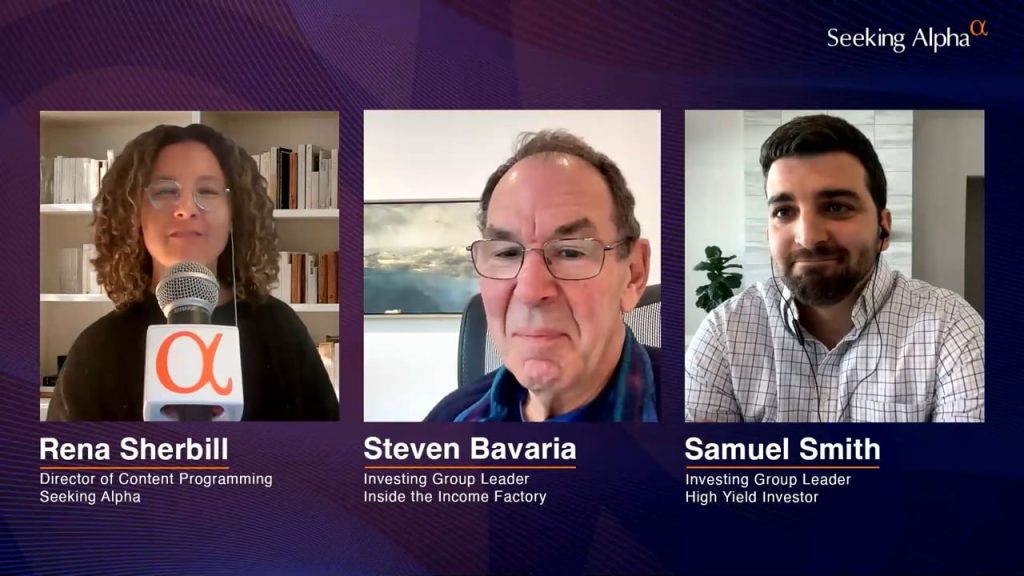
Rena Sherbill: Good morning, good afternoon, good evening to everyone attending. We are very, very excited to have you here for our Investing Experts Live Top Ideas for 2026. I will be leading the first session with our stalwart income investing group analysts Samuel Smith and Stephen Bavaria. You know them, you love them. Their analysis has been very, very informative and compelling for many, many years. This year, I think we could all do with some insight, with some cogent analysis.
We are in some perplexing, some distressing, some compelling times. There is bad news. There is good news. There are questions. There are some answers, probably more questions. Are we in evaluation reset? Is this a market correction where overextended asset prices, particularly in high growth sectors? Are they going to sharply decline to more sustainable levels? That’s 1 question. I opened up the Wall Street Breakfast podcast and newsletter today. I saw gold surging past 5, 000. I saw silver notching new highs.
The US consumer confidence index declined today almost 10 points in January. The chief economist at the at The Conference Board said confidence collapsed in January as consumer concerns about both the present situation and expectations for the future deepened. All 5 components of the index deteriorated, driving the overall index to its lowest level since May 2014, surpassing those COVID-19 pandemic deaths. The former Kansas City Fed president recently said that inflation is likely to increase after this year’s midterm elections. Yes, we’re in another election year driven by the substantial fiscal and monetary stimulus currently fueling the economy.
President Trump is levelling tariffs across the globe, along with recurring threats on trade. Some countries are looking for deals of their own, given this new business environment. Canada’s Mark Carney came back from China looking to reset relations there, which triggered a backlash from our White House. Trade blocs are looking to ink their own deals, like the free trade agreement signed between the EU and South America.
Another one just wrapped up, which has been referred to as the mother of all deals involving 2 billion people in the landmark pact between the EU and India, which represents about one third of global trade. We’re seeing a lot of earnings this week. Apple, Microsoft, Meta, Tesla, Boeing, Visa, MasterCard, Exxon, Chevron, so many things to get into before we even get to midweek and the Fed meeting, which comes on Wednesday. The market is already heavily pricing in the chance that rates are going to be a hold, that’s 99%.
Kim Khan, our favorite host of Sunday’s Wall Street Brunch and Wall Street Lunch, our podcast from Wall Street Breakfast, he asked the question the question that Chairman Jerome Powell is going to be asking is about the criminal investigation launched by the White House into Powell’s tenure and the Fed about the renovation of the central bank’s headquarters. So many things to get into politics, economy, stocks, investing. Analysts on Seeking Alpha and elsewhere have called these times unprecedented. There is so much to digest. I myself, you may know me as host of our Investing Experts podcast.
We’ve had Stephen and Samuel on a few times to great reception. I’ve been at Seeking Alpha since the scary old days of 2008 and for some context, those were some scary times, those were some confusing times. We did not know what was going on. We saw great financial crisis, a pandemic or green rush, a gold rush, a silver rush, a chip rush, panic selling, mad amounts of hopium all along the way.
There are so many things to discern from these times. One of my favorite Seeking Alpha writers is Scott Galloway, and he wrote this almost 9 years ago in 2017. And he said, and we’re getting to the crux of the presentation in a couple of minutes, bear with me as we lay out the intro. Jamie Dimon, this is what Scott Galloway said, Jamie Dimon’s definition of a financial crisis is something that happens every 5 to 7 years. An asset bubble is a wave of optimism that lifts prices beyond levels warranted by fundamentals ending in a crash.
I promised myself that I’d be smarter the next time. Next meaning on the cusp of a pop or a recession. So how do you identify when we’ve entered the danger zone and how should you adjust your behavior and or your actions? That is what we are here for today. As I mentioned, the first session coming up right now is with our fantastic income-focused investing group leaders, Samuel Smith and Stephen Bavaria.
In our second session hosted by the fantastic Daniel Snyder, we will have Andres Cardinal and Beth Kindig. And just to kind of segue into what we will be talking about and where we’re coming from. I thought that I would quote from one of America’s founding fathers, Mr. John Adams, who said, all the perplexities, confusion, and distress in America arise not from the defects of the constitution, not from want of honor or virtue, so much as from downright ignorance of the nature of coin, credit, and circulation. In that spirit, I hope that you enjoy these presentations.
I’ve always called, since I’ve been here, always called Seeking Alpha, Seeking Alpha University. You can afford yourself so much knowledge for very little price, and you really, really get some knowledge and insight. And my favorite thing of all is context. So with that spirit in mind, I would like to introduce Stephen and Samuel. We’re going to start with Stephen’s presentation of his investing strategy and his number one pick for 2026.
You will find very different strategies coming at you right now, even though they’re both under the column of income investing. Stephen, I’m so, so delighted to have you here again. Thank you for making the time. Please share with listeners your strategy and your pick and what else you have to say on this momentous year of 2026. Thanks again.
Steven Bavaria: Wow. Thank you, Rena. That’s a hard act to follow in a way you’ve given away, not given away, but you’ve given much of what I was going to say. I take a very cautious approach all the time because I agree with Jamie Dimon, at least about crises coming regularly. We never know exactly when they’re going to come, but you have to be prepared for them.
So my investing approach, and all of this is in an article, by the way, that will be available publicly within a couple hours after this presentation. But, and also I’m going to talk a bit about my Income Factory philosophy first, because none of what I invest in or my pick for the year probably would make much sense if you don’t understand the unusual, but not as unusual as it used to be philosophy that I have of investing that I call the Income Factory. Let’s see, how do we move it? Here we go. When I started talking about an Income Factory about 10 or 12 years ago, I got a lot of pushback from readers and other writers that it was sort of heresy that you can – the only the only way to grow if you if you’re investing for the long term and you want to grow your income and your investment for the future, say for when you’re retired for a lot of us, is to do it through growth stocks. My Income Factory strategy was basically a way to create your own growth of your income stream by reinvesting and compounding high cash yields. So you wouldn’t be as dependent on capital gains as you are in a traditional equity growth strategy. And a lot of people said, well, you can’t do that. You got to have growth stocks.
But eventually basic math, math is math. And that prevailed. If you understand the total return is dividend yield plus capital gain or loss, you can have a 10% yield and a 0% capital gain or a 10% capital gain and a 0% yield, and they’ll both give you a 10% total return or 5% and 5%. So now years later, I’ve got 20, 000 followers inside the Income Factory is fortunately number 4 now of your 131 investment services on Seeking Alpha. And McGraw-Hill was kind enough to publish my book, The Income Factory, about 5 years ago.
So we’ve come a long way. And what advisors don’t tell their clients, because why would they, is that you really can’t, I mean, you can seek alpha all you want, but if alpha is defined as being above average, you’re not going to achieve it if the average person won’t beat the average or the average wouldn’t be the average. But more than that, most investors who try to beat the average actually do worse than the average for all kinds of reasons. They try to market time, they bail out at bad times, so they’re not necessarily in the market when it takes off.
When the train pulls out of the station, the investment train, there’s no conductor to say all aboard. So if you’ve been out of the market for various reasons and you’re not in it, a mistake like that can hurt your investing for a lifetime, a few of them. So successful investing and Nobel Prize winners have written about this over many, many years, you know the best way to invest long-term for the average person is to index. And this is what Vanguard and John Bogle, it was created on this idea years and years ago.
So if you want to achieve the long-term equity average of 9% or 10%, and you do it through indexing by holding tight year after year, decade after decade, you’ll double your money and then redouble it every 8 years at 9 percent. So you’ve quadrupled your original money in 16 years, you’ve got 8 times of it whatever that’s called, octuple, I don’t know, in 24 years, 16 times in 32 years. That’s how you can really build for the long term. And yet even that, — oops, is my, let’s see, my slides aren’t — here we go. Yeah, the reality can be challenging, as we say.
Even indexing can be very scary for a lot of people because the S&P average yield is only about 1% to 1.5%. So to get your average, even whether you’re indexing or in growth stocks, you’ve got to have an additional 7% or 8% in capital gains on average every single year. And that means you’re up 15%, one year you’re down 10%. It doesn’t come all in a consistent, your average is just your average, it’s not consistent. So the biggest mistake that index investors make, just like other investors is they get defensive, they lose their nerve, they don’t stick with it.
And really, that’s hard. And again, all it takes is a few timing errors and you’ve crippled your lifetime investing program. So I came up with the Income Factory. I call it building wealth without the angst. And the wealth I’m building is your income, your future income, by creating your own growth, by reinvesting in compounding.
Now, if you do that with corporate loans, high-yield bonds, utility stocks, and I do it all through funds. You can generate consistent interest and dividend income, which might be depending on what you choose, might be 6%, 7%, might be 8%, 9%, 10%. Currently, it’s even been higher that in various high yield funds. But that’s net investment income is what the accountants call it. I call it business as usual income.
It’s the income you get from a portfolio in cash every year, regardless of what the market price has been doing. So since you’re not relying on capital gains, even during periods where the price is down, you’re still collecting that steady cash. And if you’re reinvesting and compounding to create your own growth, you can take that sort of river of cash, as I call it, reinvest it. And when markets are down, you’re reinvesting it at bargain prices and getting even higher yields than you perhaps were 6 months earlier. So it’s not a strategy for everyone, but the emphasis on cash income rather than market price has changed thousands of people based on what I’m hearing from my readers and everybody out there.
For thousands of people, it allows them to sleep better at night and not worry so much about market ups and downs. I don’t know if this slide is showing. It just shows the title of the slide. There it is. It’s, you know, this sounds great in theory, but what about this year?
And, you know, I could not do a better job or even as good a job as Rena did in listing all the things that concern us all, whether we’re investors or just citizens about what’s going on in our world, geopolitically, politically here in America, economically, the impact of the political and geopolitical things on our economy, tariffs and going to war with our own best friends in NATO, those kinds of things, they’re not going to help, let’s put it that way, the investment climate. So When I think about what’s our best pick, if I had, I wouldn’t pick just 1 pick obviously for the year, but if I had to come up with 1 ideal candidate, I’d want something, with a real demonstrated record of performance. This is not going to be an exotic or glamorous pick, certainly from me. Anyone who knows me knows that the Income Factory is really about finding a way to watch the grass. It’s like watching the grass grow, but you got to have the right grass.
And, you know, so I want a demonstrated record of performance, you know, something that’ll certainly do well if markets do well, but will also muddle through and be stable, you know, give us at least as much stability as we could hope for if things go south. So here we go. For me, my pick of the year is the Cohen & Steers Closed End Opportunity Fund. It’s a closed end fund. It’s a symbol is FOF.
And what it is, is a fund of funds. So you’ve got this closed end fund that holds over 100 other closed end funds. So in that sense, it’s an instant Income Factory, but more important, it’s actively managed by Cohen & Steers and by a management team, the head of which has been doing it for years and years. A very solid total return record, and this one had a chart on it originally.
Wait a minute, let’s see. There it is. Yeah, it’s got a total return record going back years, but most important for the past year, I mean, while it’s earned over 10%, both measured by its market price return and its NAV return, net asset value return, which is how most mutual funds are measured, it’s earned over 10 percent for a year, for years. But it’s also, and we’ll see, it’s got a very nice total return. But I want to mention over the past year, its market price return has been 13.3%, but its net asset value, the value of the assets within the fund has actually increased by 20 percent.
That means the market hasn’t given it nearly as much credit as it sort of deserves given its 20 percent NAV return. That means it’s a much better buy today in terms of its price than it was. It was at a premium a few — earlier last year where now it’s at a slight discount. And then many of the funds it owns are also at discount. So you get some discounts on discounts when you buy a fund to fund that owns other closed end funds.
Because your fund that you’re buying can be at a slight discount, but if it’s buying other funds that are at even bigger discounts, you get those discounts as well. Anyway, FOF has a fully covered, it’s around 8% normally, it’s about 7.7% now, it’s cash distribution. It’s the same exact distribution that’s paid for almost 20 years, which means it doesn’t push it. Some funds, they’ll take their distributions up, but then they have to bring them back down again if they’re not earning it. FOF makes a point of keeping their dividend very attractive, close to 8%, but then they don’t push the envelope.
They keep some of their return in the fund. So they’re actually building, maintaining and building their net asset value over time. It’s tax friendly. So it’s great in IRAs, but it’s also good in a taxable account in that it’s about 50% or so of its recent distributions have been tax deferred, which is great. And then as I said, lots of diversification.
I had a chart, here it is, let’s see it. Yeah, it’s diversified, it’s got a lot of equity funds, but also fixed income funds, some commodity funds which it’s moved into recently, which tells you it really is actively managed because there’s been a lot of interest in silver and gold and other commodities lately. And FOF gives you a foothold in that as well. So that basically is it.
The bottom line here, just to recap, it’s got a great record. And I think it’s demonstrated its ability over time that if things go well this year, and a lot of people are saying that despite all the BS going on in the rest of the world and in our politics that our economy and our stock market may just muddle through and do well, and I hope it does. If that happens, FOF will do fine, because it’s got a great record over time and it does well in good markets. But it’s also conservative enough that I think it, and a lot of the funds it owns, their distribution rates, even if they have to bring them down a little, it’s not going to be drastic.
So you’re going to see what I’d call the sort of muddling through adversity, even if things go south, that I look for. So that’s exactly what I’m looking for and hopefully won’t be a turbulent 2026. But if it is, I think this sort of an investment will make me and, you know, will make us ready for it.
RS: And I think, Stephen, thank you for sharing that and thank you for sharing your insights. You know, I’m never disappointed by what you have to say. I don’t think our audience is either. That’s some cogent analysis for these times, I would say. Thank you for that. We’re going to get back to Stephen after we hear first from Mr. Samuel Smith, investing group leader of High Yield Investor. Samuel, I am going to be in charge of your presentation. Just explain it, but talk us through it. Here we are. Talk us through your investment strategy and your pick for this year, please. Yeah.
Samuel Smith: Awesome. Great to be with you, Rena and thanks for that presentation, Stephen. Good to meet you in person, so to speak, or at least virtually in person. I’ve read your book. Great stuff.
So yes, just to build off what Both Rena and Stephen have said, I too am not one of these, I’m just going to pick 1 stock type of person. At High Yield investor, we definitely implement portfolio diversification. For example, the past several years, for some of those reasons you mentioned at the introduction, Rena, the growing geopolitical risks and tensions, the growing fracturing of the, you could say the unipolar world, the decline of the dollar, the de-dollarization trend, et cetera, really in late 2022 in the wake of Russia’s invasion in Ukraine, that trend had started. And so we had been diversifying into various income opportunities and precious metals, gold and silver. Those have obviously done very well for us.
But our bread and butter at High Yield Investor is dividend stocks. And In particular, as you can see there on the slide, our investing strategy is to target primarily high quality companies. And by that, I mean companies that have strong balance sheets, ideally durable and defensive business models. So we do occasionally dabble in some cyclical opportunities when we see that they are really out of favor and attractive yet somewhat sustainable dividends. But we primarily focus the durable and defensive business models that are still performing well fundamentally, but are facing various headline-driven pessimism.
And we drill down into those opportunities, interview the management teams, dig into, deep dive into their earnings calls, their presentations, their financials, to find where they’re in their industry dynamics, to find disconnects where there is negative press, but the underlying business is actually strong and we feel like the risk reward is very attractive. And then we diversify and some of them, you know, the pessimism is justified, but many of them, in fact, the vast majority of them end up being big winners for us. And that’s what’s driven our strong performance over time.
And we find that with these opportunities in many cases, even if some of the pessimism is justified, if it’s trading at a deep enough discount, it becomes a coin flip scenario. I don’t know how many of you guys are familiar with Manish Pabrai. He’s a famous Indian investor who’s modeled his approach after Warren Buffett in many respects. He’s a value investor. You can see him on YouTube and other places. Good interviews, always worth listening. He’s also got a good book to read.
But basically, it’s a coin flip. Heads I win, tails I lose, but I don’t lose much. And so that really gives us a attractive asymmetric advantage in our investments and so today I’m going to be presenting Blue Owl Capital, it’s not OBDC the BDC, it’s ticker symbol OWL. It’s an alternative asset manager that manages BDCs like OBDC, and they also have another publicly traded one, Blue Owl Technology Fund, OTF. And I believe that this opportunity gives us an attractive current yield and a deeply discounted valuation along with significant growth potential. So that even if it massively underperforms what both the consensus analyst estimates and management’s guidance indicate for growth, when you factor in the yield and it’s deeply discounted valuation, it should still very likely deliver double digit annualized total returns, but it has potential to deliver really big total returns if everything plays out nicely.
So you can go to the next slide. So as I said, it’s an alternative asset manager, has over $295 billion in assets under management. That puts it into the tier of large asset managers, obviously lower AUM by considerable margin and say that the largest ones like Blackstone and Brookfield in the alternative asset management space and obviously KKR is a big player, Carlisle Group, Aries, Apollo, et cetera, but it’s in that club of big boys. And what really sets it apart is that it has about 75% of its assets under management are in permanent capital and 86% of its fee related earnings come from permanent capital. So that gives it a much more stable and recurring fee stream than many of its peers.
In fact, not only that, but it also does not have exposure to carried interest. All of its earnings come from fee related earnings. And so as opposed to Blackstone, for example, that generates a lot of its earnings from carried interest, Blue Owl Capital is more defensive and durable in terms of its fee stream. I think it’s also worth mentioning – you can go to the next slide, that this means that they don’t have to re-raise expiring funds as much because what they do with their permanent capital funds is they typically have a liquidity event where the people investing them can then sell out of the fund, but it just goes to another investor. For example, their permanent vehicles like OBDC, the BDC, you have complete liquidity there, but unless the company, the manager decides to buy back stock, which they do on occasion, that fund, they still own it, regardless if the shareholder changes hands.
So that’s really beneficial for them. Another thing that doesn’t benefits them is that they can invest with a long-term time horizon. Instead of saying, oh, this fund ends in 5 years or, you know, it’s coming towards its end. I’m going to need to take measures to try to ensure that I get a decent return in the short term so that the client has a good experience that they’ll come back again to reinvest. They say, oh, well, I have a long time to stay in this fund because it’s permanent capital. And so they can invest for maximum risk-adjusted long-term total returns because they can take that long-term approach.
That’s a competitive advantage they have as well. And not only that, but the assets that they invest in primarily are more defensive in nature, like senior secured first-lien loans that they allocate to, triple net lease reinvestments to investment-grade counterparties. So, very, very defensive. Think like a Realty Income or an Agree Realty type strategy, or even, but even more conservative because they’re almost entirely invested in investment grade counterparties or even their data center leases where they own a data center or they finance a data center and the counterparty is Meta or some other high, high rated, very cash rich company. And so they have a more defensive approach. And so that also sets them up for more defensive setup.
All right, you can go to the next slide. And on top of that, as an alternative asset manager, they run a balance sheet light business strategy. And that means that they are very cash generative. Instead of owning the actual assets themselves, they simply manage the funds. And so their clients own the real estate, their clients own the loans, et cetera. And so they simply just earn, like I said, that stable fee stream, the fees from the funds that they manage. And they have very limited capex requirements. And much of their growth is either via them issuing shares to acquire another business on an accretive basis. And of course, the company that they’re buying receives those shares, typically has a long lockup period to ensure alignment as they join the company or they may borrow some money or they may use some of the return earnings to buy companies but most of their growth is through organic fundraising and so that’s very capital light that’s a very high return on invested capital type venture.
And so they can return virtually all of their cash flow, and they do, to shareholders via buybacks and dividends. And they primarily do so through a dividend. And so that is a big advantage because it enables them to have a high payout ratio and therefore pay out a high dividend yield, which currently it’s at 6.2% yield, while also generating very strong growth. And so Blackstone has done that. Brookfield is now doing that with their BAM.
KKR has done that, et cetera. And those companies all have phenomenal long-term total return track records, largely due to this. They can give you the best of both worlds, the high yield and the strong growth. All right, go to the next slide.
And also, importantly, they also have a strong balance sheet. So they are asset light. So that, for one, reduces the capital requirements. Like you’ll see a lot of companies that may have an attractive dividend and even fully cover it with earnings, like, for example, AT&T a number of years ago. But they had to cut their dividend because they had such heavy CapEx requirements and they had a lot of debt that they had to take over the years to support that business that they had to cut the dividend to retain capital to fund their CapEx and to pay down debt. Whereas OWL doesn’t have that.
On top of that, while they do have some debt, it is very well laddered out into the future. They have basically very minimal debt maturities until the 2030s and even have debt dated out to the 2040s. They’ve got plenty of liquidity to handle any of that. And so they have an investment grade credit rating. So that’s another thing to keep in mind.
Next slide. Okay. Another thing I really like, like I said, they have that really attractive yield. When I made this slide, it was just under 6%. It’s come down a little bit since then. So you get an even better deal than when I initially put this slide together. It’s now a little bit over 6% yield. And they are projected based on analyst consensus estimates through the end of 2029. So through the end of the decade, they grow their distributable earnings per share at a 15.7% CAGR. So you put that plus the yield, you can do the math.
That gets you over 20% right there. Meanwhile, management, last year at their Investor Day presentation, and I spoke to the company toward the end of last year, and they reiterated their conviction in this guidance, that they expect to grow at a 20% plus distributable earnings per share CAGR over the next 5 years, and that was a year ago, So for the next 4 years, or really through the end of the decade. So that, you know, again, they’re even more bullish than analyst consensus is. So, you can pick which one you like, but even if you go with the analyst consensus estimate, that’s still very attractive without needing them to outperform. In fact, again, they can underperform even the analyst consensus estimates and you’re still getting a something in the teens annualized return without needing any valuation, multiple expansion.
All right, go ahead to the next 1. All right, now of course you could say, okay, this sounds too good to be true. What’s the catch? And of course, there is always a catch because the market may be inefficient at times. I’m one who does believe in an inefficient market.
My own track record shows that obviously you have many others like Warren Buffett, who are much obviously more accomplished than me, but there are plenty of examples of investors who can routinely outperform the market. It takes a lot of work, but it is doable. But of course, there’s always a pushback. And so if you see an investment like this that sounds so great, you need to pause and take a deep look. In fact, they have an over 12% short interest right now.
OWL does as per Seeking Alpha as reporting. So, you know, there clearly is a bear case here and there are really 2 big prongs to the bear case. The first one is the private credit concern. Blue Owl has over 50% of their AUM. It’s about $152.1 billion dollars of their AUM. So it’s amounts to about 52% invested in private credit direct lending. So that’s a pretty significant concentration in 1 of their segments. And as those of you who have followed the space, who may follow BDCs, et cetera, there’ve been a lot of headlines over the past year that have been negative on private credit. You’ve had a couple of high profile defaults or write downs, Although some of them have been actually been misattributed to private credit. 2 of the biggest ones are actually bank underwritten deals, not direct lending underwritten deals.
Another one was just a case of outright fraud being involved, which could happen to anyone. And so, you know, the sector as a whole has actually held up quite well, but we’ll get into a second. But regardless, there are concerns that because so much capital has poured into the space in recent years as it’s gotten very popular with a lot of these alternative asset managers, and even some more traditional lenders are getting into this space, that there’s now an imbalance where there’s too much capital chasing too few opportunities. And so that’s led to spread compression, which has hurt some of the returns. There are also concerns that underwriting standards are slipping, although there’s no hard evidence of that.
There’s concern about that. Additionally, concerns about the economy, as Rena shared at the beginning with declining consumer confidence, has led to some concerns that we’re going to see a downturn in NAV, for example, on these funds and weakening returns. And of course, if all that played out, it would be materially negative for OWL because again, they’re concentrated in it. Even though they don’t own the loans, they still earn fees from them. And the biggest part is if sentiment on the space truly was impaired, that could hurt their fundraising, which has been very strong in that space and therefore reduce their growth.
You can go to the next slide. Okay, I do think these concerns are overstated largely though because first of all, the industry is not new. It’s not some new hot phenomenon that’s unproven. The private credit industry has been around for quite some time. It’s been through numerous economic cycles.
You have names like Ares Capital Corporation, Main Street Capital that have been through the great financial crisis, they’ve been through COVID, et cetera, and they’ve weathered them quite fine over time. Of course, an economic downturn does hurt in the near term, but this hurts anything. This industry has done well. Owl Rock, which is Blue Owl’s private credit business, existed for quite a while before OW went public. They’ve operated for over a decade and they have a loss ratio, historical loss ratio of just 13 basis points, which is extremely low, way below high-yield bonds, leveraged loans, or any other potential peer comparable out there.
So they are a proven track record. They’ve gone through COVID, and they’ve done a great job. So that gives me a lot of confidence in Blue Owl’s underwriting. They invest in a very small percentage of review deals. So they’re not one of these people that’s just taking on, you know, tons of capital and just throwing out whatever deals that come across their way to earn fees.
They’re very selective. They take great pride. They have a very good team in ensuring that they keep their loss ratio very low and are very good risk adjusted returns for shareholders. Along with that, they invest like 90% roughly of their loans are in senior secured first liens. So that again, that senior in the capital stack position does add additional security.
They also are very highly diversified with very low percentage in each loan. So their portfolios are very well diversified. So even if they do have a couple of bad loans, which every lender does inevitably, it has a minimal impact. You can go to the next slide.
And we see this again, not just what they’re saying and reporting, but if you look at their publicly traded BDCs, OBDC and OTF, they both have very low non-accrual rates. OBDC, which is more of a traditional diversified BDC, has only 1.3% non-accruals on a fair value basis, and only 1.4% of their portfolio is rated an internal risk level of 4 or 5, which are their 2 worst. Again, virtually the entire portfolio is 3 or above, which is considered not on the verge of any major issues. Their technology one, which is a software lending business, is even better. They have only one company in nonaccrual, which represents just 0.1% of the portfolio at fair value. And again, that’s the one that’s rated risk level 4 or 5, the rest of the portfolio is doing well.
Go to the next slide. And I guess one other thing I’ll just mention there too that I forgot was that they do have a third party perform their internal marking of their loans so it’s not just them making up stuff to say, oh, everything’s great. They do have internal third party group to come in and look at their loans every quarter to mark it. So That helps along with the fact, again, they have this long track record. If they were fudging the numbers, it would bear itself out with spike in nonaccrual and ultimate losses, but they’re very low loss rate as evidence against that.
Okay, the second part of the bear case is pertaining to their real asset business where they invest in data centers. And what they do is they either provide financing or they actually outright own the data center. And then they lease it out to a counterparty like Facebook, or I guess you’d say Meta or someone like that. And so the big complaint here is that, okay, we have a big CapEx boom in AI, and that this is going to end up bursting here in the next few years because these companies like Oracle, Meta, etc., all taking on tons of debt, and they’re going to get poor returns on investment, and they’re going to decide this isn’t worth it, and they’re going to pull the plug, and someone like Blue Owl is going to be left holding the bag. Now there was even some popular analysts at JP Morgan even went on a podcast recently and basically criticized Blue Owl and indicated they’re going to be left holding the bag when the plug gets pulled.
But he actually came back later and issued a mea culpa and admitted he misunderstood things when he was talking about it. And so really, the issue here is that Blue Owl has a lot of protections. First of all, the debt that’s going into these data centers, for example, the meta deal that was the one that got a lot of the publicity, PIMCO was actually the one that was providing the debt for that, not Blue Owl. And so that’s completely off their balance sheet, off their funds balance sheets. And even the investment here is on their fund balance sheets.
So Blue Owl itself doesn’t own it. It’s their clients that own it. So again, that’s additional installation for Blue Owl. And third, their contractual make whole agreements that even if Meta walks away from the lease, they have like every 5 years, they have a walk away clause or something like that. There’s a contractual guarantee that the clients at Blue Owl and their funds will earn a contractual return that’s actually quite attractive, even if Meta breaks the lease.
So, again, it’s a very low-risk investment. It’s effectively, you could say, kind of a preferred equity-type setup where they should do well. The only way they’d really lose money on this is if Meta itself goes into financial distress and can’t honor the make whole agreement, which if that’s happening with a company like Meta, and you look where the market’s pricing it, and the market as a whole on mega cap tech stocks, the entire market is gonna be collapsing. And I don’t think a defaulted lease in one of Blue Owl’s funds or 2 of its funds or whatever is going to be, you know, the story people are worried about. I would also just note that today the digital infrastructure business for Blue Owl is only 5.2% of their total firm’s AUM.
Now it’s expected to grow a lot in the coming years because they do view that as a very attractive business for them that’s in demand and meets a need. But in terms of the risk to them from today, it’s very low percentage of their business. So even if that business goes bad, it’s not a big deal, not like private credit, which is of course a much bigger percentage. All right, you can go to the next slide. Okay, you can go to the next 1 as well.
Okay, so The third component of the thesis here is in addition to those 2 bear theses, they get a lot of press, there have been a lot of articles written about both of those, and I think that they’re just reflective misunderstanding of the business and the state of it right now. Another big reason to really like Blue Owl is that there’s a clear valuation disconnect. So it trades about 17 times forward earnings, a little less than that. It has, like I said, around a 6% dividend yield. But not only is that attractive on its face, especially when you look at the growth rates that I mentioned earlier, but if you compare it to its peers, like, for example, Blackstone, Blackstone trades at 25 times earnings with a 3.4% dividend yield.
So materially higher, about a 50% premium in terms of its price to distributable earnings ratio, just a little bit over half the dividend yield that OWL offers. Yet it’s only expected to grow at a 17-ish percentage CAGR through the end of the decade, which is about what analysts are expecting OWL to do. And OWL’s own management expects an even higher growth rate. Brookfield Asset Management trades at 29 times earnings with about a 3.8% dividend yield. It’s only expected to – grow to 16% CAGR.
Again, clear disconnect, similar growth rates projected, but way richer valuation, lower yield. Ares management, which has a substantial presence in private. And all these businesses, by the way, have significant private credit and or AI infrastructure exposure. Ares Management trades at 26.5 times earnings, yields only 3.2%. Again, expected that mid to high teens annualized growth rate.
KKR, 20.5 times earnings, only a 0.6% dividend yield with about a 20% expected growth rate. So a little bit higher growth rate, but way, way lower dividend yield and trades at a premium valuation. Apollo Global Management, which by the way, has about 80% of its AUM in credit. So it’s much more risky in that front than Blue Owl Capital is. Only yields 1.5% while having a similar yield and growth rate expectation that Owl has.
So no matter which one of these other big boys you look at, OWL is clearly the best combination of yield, growth, and value. And again, I think that the big criticisms that somehow it’s a lower quality manager just don’t hold up under the scrutiny that I just shared. And you can go to the next slide. And really, as a final takeaway here, I would just add this isn’t just my opinion. Insiders are putting their money where their mouth is on this.
So senior management gets all their equity there. It gets all their compensation in equity, Blue Owl stock. And so they’re already heavily lined with shareholders without having to buy any of themselves. But that being said, they still purchased over $15 million worth of shares just this past November and December at a stock price that’s very similar to where the stock is trading today. $15 million, that’s not a little bit.
Not only that, but the company itself repurchased more than $50 million worth of the stock under its buyback program. On top of that, the subsidiaries, the publicly traded BDCs, OBDC and OTF that I mentioned earlier, they repurchased approximately $115 million worth of their own stock on a combined basis during that same timeframe, and Insiders in those 2 companies purchased more than $20 million of stock. So again, there’s clearly a lot of confidence in their private credit business. There’s clearly a lot of confidence in OWL as well on the insider basis. So when you combine all that with the strong credit rating, the significant liquidity, the growth track record, the asset light fee-based earnings business model with the high yield and the attractive valuations compared to peers with, again, just that misunderstanding about the 2 big risks that they’re getting and all the negative headlines. I think this is one of those asymmetric bets that is currently hated, but I think for patient investors who can ride the negative headlines and the volatility that comes with it are going to be richly rewarded over time.
You’re muted, Rena.
RS: Hello, just nothing without a technical difficulty, nothing without a little fail ability. Samuel, thank you for that very much. Really appreciate that take.
As I mentioned, I’m used to hosting the Investing Experts podcast, which we are not afforded live questions. And that’s one of the great things about these live events is that you can ask questions to 2 great investing minds. But Before we get to the Q&A, I want to leave a bunch of time for that. We have over 30 minutes to get into that. But Steven and Samuel, I wanted to give you each a chance to reflect on the other, each other’s presentation or things that you may have forgotten to bring up or things of value to note for investors.
Steven, I’ll start with you. Do you have anything to mention before we get to the Q&A?
SB: Yes. Samuel’s presentation was terrific. He’s a real analyst. I’m a portfolio manager and generalist, but he really delved into it. I was checking out Blue Owl, and one of my favorite funds is PBDC. It’s an ETF. It’s the Putnam BDC, and it’s an actively managed BDC fund. And I was looking at it while he was talking and noticed that 2 out of its 3 top holdings, I think, were Blue Owl entities.
One was the Blue Owl BDC, and then the other one was another Blue Owl. You probably know more about it, Samuel. But anyway, Blue Owl was right at the top of their list, which I thought sort of, you know, helped your case, not that you needed it.
RS: Samuel, thoughts?
SS: Yeah, sorry. I was muted there. Yeah, no, I hadn’t noticed that, but I see it now. Yeah, they had the Blue Owl technology fund, which is their second largest holding and then tied for third is the OBDC, the Blue Owl Capital Corp. And it’s nice to see that confirmation. I mean, I agree with them.
I actually – full disclosure, I just bought some more shares of OTF this morning, we hold that as well as OWL, at High Yield Investor, and I’m very bullish on their, their, their technology, their software lending business as well. But yeah, no, that’s great to hear.
And as far as your presentation, I can definitely see the appeal that approach for an investor who, again, doesn’t want to have to deal with, you know, digging into individual stocks and wants to just have a portfolio that pays the cash. And I completely agree with your emphasis on the income component, especially for someone, you know, in retirement who’s not trying to set records. They’re not necessarily trying to beat the market. They simply, they’re more concerned about sequence of returns risk, rather than absolute total returns. I think of an analogy that Howard Marks, you’re probably familiar with him. He’s a famous credit investor, speaking of direct lending and some of the funds you invest in are probably credit funds based on the book that I read that you’ve written. He said, you know, there’s a story about a man who was 6 feet tall, who drowned while trying to cross a river that was only 4 feet deep on average. And that’s because there, you know, there may be a period that’s, you know, if he doesn’t know how to swim and say, there’s like a 20, 30 foot span in that river, that’s, you know, 14, 20 feet deep.
He’s going to drown. And that same goes for a portfolio that, yeah, maybe the long-term return from the market is 10%. But if you go through a market crash followed by a lost decade, which we certainly could encounter, and he’s also recently pointed out that where the S&P 500 is currently priced, Historically, it’s always delivered around 0% average annualized returns in the decade following, whenever it’s reached this level. And we see what’s going on in the world as Rena was mentioning at the beginning that wouldn’t shock. I’m not making that prediction, but it wouldn’t shock me at all if that happened.
And so if you’re an income investor instead, especially if you’re invested in credit, you know, contractual returns from debt investments and you’re diversified and you have some quality managers, which, you know, I believe Blue Owl is one of them, you know, even if you have a few credit losses, you’re still going to probably get a high single digits annualized return that’s consistently being paid to you via those contractual payments and you’ll survive your retirement. And so again, as Warren Buffett once said, it’s insanity to risk what you need and have, namely your principal and that steady stream of income in retirement in order to risk that in order to get something that you don’t have and you don’t need. If you’re a retiree and you have a good nest egg, you don’t need a 20% annualized return. Hopefully, you don’t need a 15% annualized return to meet your needs in retirement. And so it’s better to hedge your bets and sign up for a more secure 7 to 10 percent return that you get consistently than go for the volatile ride and put yourself at risk for coming up short.
So anyway, I really appreciate that component of your strategy. And I try to implement something similar in my retirement portfolio at High Yield Investor, albeit with some different vehicles than you use. But I think you can get a similar outcome.
RS: I would say patience and common sense still at a premium during these times, maybe more than ever, but still really, really important to hold onto those 2 things. Steven, any further thoughts before we get to Q&A?
SB: Well, yes, again, I think Samuel and I are really on a lot of the same page, even though we have somewhat different strategies that may reflect various differences in where we are in our lives and our personal investing careers. I think back, you know, if you go back in before 1980 or so, most people had jobs where they had pensions as opposed. Now we have to create our own pension, so to speak, through our 401Ks and our IRAs. But in the old days, if you will, when people had defined benefit pensions, they looked forward to retiring on a pension, and they didn’t even think about how many assets the pension company had to have in order to pay me X amount per month. When that changed, it got us as retail investors thinking a lot more about how to do the investing ourselves.
But it’s that income that you’re, to me, it’s the income that provides the source of economic value. In other words, in fact, the famous economists have written that it’s the market price of something is the discounted current value of all of its future cash flows. And if you think about the value coming from the income you’re going to get, it makes it easier to sort of forget about short-term market movements and focus on that income.
RS: Samuel, I’ll leave you with the last word before we get to some Q and A if you want.
SS: Let’s go to Q and A.
RS: Let’s go to Q and A. And does everybody know what’s cooler than one outstanding investment analyst is 2 outstanding investment analysts. So super happy to have you both here and thanks for diving so deep. Okay, number one question. Will your picks withstand geopolitical stress from trade wars? Dun, dun, dun, dun. I think we kind of answered that, but let’s get into it.
SS: Yeah, I mean, I guess I’ll just say with OWL, again, this pick is, as I mentioned at the beginning, everything needs to be taken in context. I’m not saying just buy this stock, especially with a controversial battleground pick like OWL, This is probably more on the risky end of the spectrum, especially if you’re a retiree focused on income. I think OWL is not necessarily a high-risk pick, like you said, it has a strong balance sheet, I think it has a good durable business model, and I think the risks are overemphasized.
But it is going to suffer if we experience a big downturn in the economy. And so, you know, obviously trade risks, the big risk there is that, you know, trade just clams up between US and its main trading partners, and that would undoubtedly indirectly hurt OWL. I don’t think it will directly hurt it, but indirectly it will. And that’s why you diversify into other positions. But I think for an offensive part of your portfolio where you’re trying to hit a bigger home run, I think OWL is a great pick.
RS: Mr. Bavaria?
SB: I agree about OWL. And I also think FOF, while it’s not as glamorous an investment in terms of its upside potential, also has, because of the way it’s run and the way that the fund managers have not paid out as much distribution and made their yield as high as they might have. They’ve kind of kept some in reserve to the extent closed end funds are allowed to do that by not taking capital gains, by letting their winners run, that sort of thing.
I think is in a pretty good shape to withstand some downturn. Now, if it goes on for years, maybe not, but certainly I think they can keep their distribution up through, you know, by through their managed distribution through a 6, 12 months or so of turbulence.
SS: Yeah. And let me clarify with OWL. I think the dividend will be sustainable in all but like a major economic collapse where private credit gets really hit hard. But as long as it’s not like a huge economic downturn just a mild recession or something like that I think OWL’s dividend will be fine and likely will even keep growing I’m just saying the stock price will probably get hit pretty hard if market sentiment turns south.
RS: Okay, next question. What about the taxes on dividend income? Taxes on capital gains are deferred until gains are realized. Thoughts?
SS: Yeah, OWL, their dividends are generally classified as qualified dividends because it’s a C corporation. So I think some of their dividends may be considered return of capital in certain scenarios, but I think most of the time, OWL’s dividends are qualified.
RS: Steven?
SB: Yeah, and sitting with fund to funds, their dividends, at least in recent years, you never know exactly till the fund sends out in January or February, sometime their exact characterization of their last year’s distributions. But in recent years, FOF has had 50% or so of its distributions were classified as return of capital, which means it’s deferred until you basically sell the asset. It reduces your basis.
And ROC, and I’ve written articles about this, scares a lot of people, but actually ROC is just an accounting term. And as long as it’s not destructive, destructive would mean if they’re paying out a dividend that’s greater than their total return, which means they’re eroding their capital or their NAV, which in FOF’s case, they’re not because their total return has been consistently higher than their distribution for the last 10 years. Any return of capital is what they call constructive and therefore helps you if it’s in a taxable account.
RS: Appreciate that. I’m going to alternate. We have some specific questions for Steven and some specific for Samuel. Steven, I’m going to start with you. Do investment grade corporate or treasury bonds play a role in your strategy or is the yield too low?
SB: Basically the yield is too low. You’re getting paid for taking interest rate risk when you buy treasury bills or bonds or even highly rated investment grade debt. You’re mostly being paid to take interest rate risk. I like to take credit risk and get paid for it, which means buying high-yield bonds, senior corporate loans, and of course, BDCs, which are primarily mini banks that do senior secured lending. In all of those, a lot of people are scared to death of what they call high yield or, God forbid, “junk.” But actually, you know, if you non-investment grade companies are the majority of all companies in the United States and the world. And, and, you ask people, do you buy, you know, high yield bonds?
And they go, oh gosh, I’d never buy high yield bonds. And then you say, oh, by the way, in your stock portfolio, do you own any mid cap funds or small cap funds? And they say, oh, sure. And then I say, well, Those are the companies that issue the high yield bonds that you say you’d never buy, which of course are higher on the balance sheet and have to get paid or your stock is worthless. There’s a lot of, and of course Samuel knows this better than I, and that’s part of his investing philosophy.
We talked about private credit and everything. A lot of these markets have much worse reputations in a way than they deserve. And the people who study them and get to know them realize that, hey, there’s good value here. You get paid for the credit risk you take.
RS: All right, Samuel, there’s a few questions about concerns that people are interested if you share the concerns about Blue Owl. I’m going to combine them all into one question, but feel free to pick it apart. Okay, here are some of the concerns that they mentioned. The very high short interest, the credit risk, the payout ratio being 105%, and the fact that Blue Owl is down 40% last year, if you’re ignoring the price performance.
SS: Okay. So I’ll go first with the big price down, price being down.
That’s exactly why I like it. A vast majority of the stocks I buy are ones whose prices are rear, like the last 12 months or so price performance looks terrible. I’m not a momentum chaser. I don’t chase hot stocks. I buy value.
And also, if you’ll note before then, it had been on an incredible run higher before it pulled back sharp. And I actually owned it. Wrote it up into the 20s and then sold and then it’s come back and so I’m buying back in. So, it’s called value investing. But the short interest component, again, I would say, I would point to the 2 big bear theses that I shared in the presentation.
And OWL is particularly targeted for this because one, it’s a little bit smaller than its larger peers, like I mentioned. And 2, it combines, it has both, even though it’s small, data infrastructure exposure along with private credit exposure. And so people who are bearish on those themes view it as a good vehicle as a proxy to short, as a way of signaling their bearishness on those themes. And so that’s why it’s particularly high amount of short. So again, if you buy that, if you’re bearish on private credit, like, and you think that it’s going to go poof, and it’s the next big bubble, then yeah, don’t buy Blue Owl Capital.
And that’s why people are shorting it. And the same, you know, the digital infrastructure, I don’t think is as big of a risk as some people make it out to be because of what I shared the contract structure is very misunderstood and it’s a relatively small part of the business at this point, but Yes, the private credit risk is if you’re just bearish on private credit, then yeah, don’t buy Blue Owl, that wouldn’t be my first choice to short either because it’s already priced so cheaply and their funds are doing quite well.
Let’s see, the other 1 was payout ratio and the credit risk. So the payout ratio, yeah, they’re slightly above Their dividend yield is slightly above where their current earnings are. But there are 2 things you need to keep in mind there. 1, they have a very large number of assets under management that are not yet earning fees. So they’ve raised those funds. They haven’t deployed them yet. And this speaks to the next question, the credit risk. A big part of that is because they’re very selective.
As I mentioned, they only invest in a small percentage, very small percentage of the opportunities that come to them. So they’re very deliberate. They know that they think long-term because this is permanent capital. They’re not chasing a quick return tomorrow. They’re saying, look, we’re going to wait for the right opportunities and then we’ll deploy the capital and so if they deployed all that capital today They would easily cover their dividend And they’re also constantly growing through raising new funds there.
Their fundraising is very prolific hence why analysts have a high growth rate target on them. And management obviously expects that as well. So on a forward looking basis, their dividend is fully covered, even if you don’t count additional fundraising just from the funds they currently have. And so that is not an issue of concern. As you can see, they’ve grown the dividend very aggressively, including last year, knowing that it would push their payout ratio temporarily up 100%.
So, you know, maybe you disagree with that approach, but it’s not a symptom of their business stagnating and dying. It’s just a simple symptom of them, you know, because they have a cap asset light balance sheet, they’re returning all the capital, all the cash they’re getting to shareholders. And so there’s some, you know, slight divergence in the earnings timing versus the dividend going out. But that’s it’s going to track over time. So that’s one thing.
And I’d also note that management has said they do expect a distributed earnings per share to grow faster than the dividend, not by a large amount, but by, you know, a decent bit over the next several years. And that payout ratio will come down to probably about 85% to 90%. So that’s something to keep in mind as well.
The last question with the credit risk, I’ll just touch on this briefly. I talked about that in my presentation, they have very low non accruals, very small watch lists, very strong track record of over a decade of a loss rate and like of 13 basis points Which is you know, just a little bit over 1 tenth of 1% of their investments is the loss rate they have.
So, stellar numbers there. Again, the senior security emphasis. And just one other thing I’d say is, it’s not just them either. I mean, Private credit at large, especially if you look at the good reputable managers like Blue Owl, you got Ares Capital Corporation, Hercules, Main Street Capital, Sixth Street’s Specialty Lending, Golub Capital, Blackstone, all the big names, they have very low non-accrual rates right now. Pretty small watch lists.
Private credit as a whole is outperforming high yield bonds and leverage loans in terms of default rates. So other than spreads compressing a bit because of that influx of capital, which, okay, that’s duly noted, there are really no symptoms of major risk to private credit at this point. So again, you can take your opinion on it, but you’re ultimately speculating and conjecturing there’s no hard data to support a bearish thesis on the health of the current credit market in the good lenders like Blue Owl and some of the others I mentioned.
RS: So you’re saying there is a difference between hard data and opinion? That’s breaking news. I’m going to UNO reverse card this for a second. And Samuel, we’re gonna stick with you. Somebody’s asking the difference between OWL and OBDC.
SS: Yeah, like I mentioned at the beginning, OBDC is a business development company. They raise equity from shareholders, they mix it with debt, and they invest in loans. And like a REIT, raises capital from shareholders, mixes it with debt, and invests in physical real estate. OWL, OWL is the asset manager. So they are the alternative asset manager. They manage a bunch of funds, including OBDC and OTF, which are publicly traded BDC. They have some private BDCs.
They also have the other businesses, the triple net lease, the data centers. They have another thing where they invest in other private equity, private alternative asset managers, et cetera. And so they manage the company. So they don’t actually own the loans that OBDC invests in. They simply manage that fund. They manage the loan portfolio, et cetera. And they earn fees from OBDC. OBDC pays them a fee to manage them.
RS: Appreciate that. Steven, I’m going to ask you a few questions in a row. I think we have time for that, and then I’m going to get back to both of you, a question for you both, if that sounds good. Steven, first question. I see that FOF owns a lot. This is not for me. I see that FOF owns a lot of gold and silver, which could lead to some volatility and a pullback on those commodities. What are your thoughts on being so metal heavy?
SB: Well, when you say metal heavy, I think that owns maybe, I don’t know, 15, 20% or so of FOF. In other words, yes, it owns more than I’m sure it did a couple of years ago. If you had looked at FOF a few years ago, it might have been all closed end funds. Now it’s branched out and it is owning, it’s hedging its bet essentially by getting into metals and commodities because so many supposedly, hopefully smart and successful so far people have gotten into those.
So I credit FOF’s management for being, you know, smart enough to, you know, diversify into some of these new fields that it wouldn’t have been in a few years ago. So I don’t know whether it’s a smart idea or not, but I’m glad it’s so well diversified. And I respect and depend on the quality of management of FOF to make better decisions than I would if I were in their jobs, probably.
RS: Fair. Next question for you, how much of the historical distributions of FOF are return of capital?
SB: Well, return of capital is not a bad thing. Although some people don’t know, I have an article about return of capital on seeking alpha, they’re welcome to go and read. But a good bit of it, which is good, that makes it a more attractive investment. The only thing that would make ROC negative is if you saw that they were paying a higher distribution than their total return. If their total return were 8% and they were paying out 10%, then that would tell you that 2% of their payout was erosion of their capital, And that would be negative return of capital, destructive.
But it’s the opposite. They pay out around 8%, but they’ve been earning 10%. So you know their payout is fully covered. So whatever portion of it is return of capital is constructive, positive return of capital that helps you from a tax point of view, but doesn’t erode your capital at all.
RS: Thank you for that. 2 more questions for you, Steven, and then 2 more for the both of you. Steven, can you use this approach in an IRA to fund RMDs?
SB: Oh, absolutely. In fact, The Income Factory was designed for IRAs in the sense that most of my investing was and still is in IRAs, although I have to take some out every year because I’m at that point where you’re required to take a distribution. But no, to the extent you’re using credit, especially credit funds, closed-end funds are like pass-through, so they don’t pay taxes, but those of us who own them, the shareholders do.
And when your money, when your distribution is sourced from interest, then it gets taxed as though it’s interest. And interest does not get qualified tax rates. Interest is taxed at regular rates. So in an IRA, you don’t care about that because you don’t pay any interest until you take the money out later on.
RS: Okay. Questions are still coming in. So I’m going to hear 2 more for you, Steven. 1, does FOF insure against currency debasement?
SB: I don’t think they insure against it. They’re denominated in US dollars. They invest in funds that are largely US closed end funds. So if you were outside the United States investing in FOF, you would worry about the risk you’d have by being in dollars. I mean, I do have some subscribers outside the United States who worry about the fact that they’re investing in dollars. And so they’re taking a currency risk between whatever their local currency is and dollars. But FOF doesn’t worry about our currency debasing because we’re investing in dollars in a fund that’s in dollars.
RS: And 1 more before we go back to Samuel, FOF is currently at a 52 week high. Is it still a buy?
SB: It’s at a slight discount when I say a buy. I don’t know if it’s at a buy compared to what it’ll be 3 months from now or was 3. In other words, I’m investing for the long-term and I’m looking at it as a source of quality distribution. So yeah, I don’t know if it’s a buy compared to what it might be in 3 weeks or 4 weeks, to be honest with you.
RS: Samuel, before I get to questions for both of you somebody just asked if you’re going to recommend OWL, why not OXLC?
SS: Very different companies so that’s that’s apples and oranges I don’t know how else to answer that, because I don’t have the time or the scope here to really get a breakdown beyond that. They’re just totally different instruments.
RS: Okay, good enough. Okay, question for the both of you. Do you factor short interest and quant ratings into your picks?
SS: Quant ratings, no, because their approach is largely driven by momentum factors, as well as often GAAP-related earnings metrics that just simply don’t apply to OWL and a value investor. I mean, again, if I was a momentum investor, I would obsess over quant ratings. It’s a pretty good momentum tool, but I’m just not a momentum investor. I take a more long-term approach. And I let volatility serve mean I don’t chase volatility. As far as short interest, of course, whenever I see a high short interest, it means it’s a battleground stock.
And so it means that you really need to look closely at the risks and not just take management’s word for granted when they give you a nice glossy presentation. So yes, in the case of OWL, that’s why I’ve done a lot of research and really dug into it beyond just looking at the investor presentation. And I’ve come to my conclusion.
RS: Steven?
SB: Basically the same answer. Certainly, as far as quant ratings, you know, I’m not I’m not a short term trader. I’m not looking at momentum moves. As far as the amount of short interest in a stock or a fund I buy, I don’t know how many of my funds are shorted very much. But that would be an indication that it’s probably at a high and maybe an unsupported high. So if I knew about that, it would probably give me a further reason not to buy it.
But something that was being shorted, it would probably be at a premium, would probably have other qualities about it that I wouldn’t like to begin with.
RS: Do you use stop loss orders? And if so, what is the strategy?
SB: No strategy, I don’t use them.
SS: Yeah, I don’t use them either because again, as a value investor, you know, if I like a stock at $10, why would I want it? Why would I like it less at 9? It makes no sense to me. Yeah.
RS: What do you both anticipate when it comes to potential interest rate cuts this year by the Fed?
SB: Oh, boy.
SS: Go ahead, Steven.
SB: Thank you so much. You know, I suspect, you know, and I only know what I read, what other opinions I read. I get the sense that there’s enough momentum in the whole Fed world. I mean, I suspect this next time around, you’re going to have votes on the committee in both directions. But I’m guessing or won’t be surprised if there’s another cut, even if it’s not necessarily economically necessary. I mean, I think there are plenty of reasons to argue that the rates could go up and down, given how we don’t know what’s happening with inflation, there’s going to be more tariff, you don’t know what’s going to happen on the tariff front, but if we do have more tariffs, that certainly could increase the cost of things. We don’t know enough about how much has been delayed, how much of US companies and importers swallowed it and absorbed as much as they can, but that their main, you know, there’s just so much that I have no idea is the long, but should have been shorter answer.
RS: But honest and we are craving honesty. Samuel.
SS: Yeah, I mean, the Fed is it seems like becoming like the rest of the United States, increasingly politicized with an administration putting a lot of pressure, and then likely some members of the board who would like to spite the current administration. And so there’s just that polarizing, like everything nowadays, you see it, law enforcement, et cetera, at various states like Minnesota. It’s the state of our country, and I don’t want to get too into politics here, but at the end of the day, that’s what it’s coming down to.
And so I think the current data does not support further cuts. My personal opinion. But I think we probably will get at least 1 or 2 more this year. But my focus is more on the long term, long end of the curve anyway, just because I think that has a much bigger impact on where valuations are going to go in terms of stocks. So I’m not one who obsesses over the Fed.
RS: I think that’s wise. Wise advice for us all probably. Okay, some specific Blue Owl questions as we’re coming to a close here. And again, thank you for everybody’s questions. Really, really appreciate adding to this conversation.
Okay, Samuel, what percentage of OWL is involved in data centers? And is there a concern about this credit aspect given the elevated CDS numbers with firms like Oracle?
SS: Yeah, so I touched on that in the presentation. Only 5%, about 5% of their current assets under management is invested in the digital infrastructure sector. Now that’s going to grow probably rapidly, but of course if it grows, that’s a good thing for OWL because they’re getting more fees out there.
So, but right now it’s a very small percentage of the business. And as I mentioned on the call, or on the presentation that they have make whole agreements with their counterparties. In fact, they recently didn’t end up doing a deal with Oracle for a data center because they didn’t like the terms. Basically, they were insisting on certain terms that Oracle didn’t like, so they ended up going with Blackstone, I think. Which again, I think speaks highly of OWL’s underwriting discipline that they are sticking up for their clients and ensuring they get the best terms possible or else they won’t do a deal.
They’re not desperate to do deals. And so, but they had make whole agreement so that if say, for example, they have a big deal with Meta. So if Meta walks away from the lease, they still get to make whole agreement that their clients get a contractual return that’s actually quite attractive. And again, that’s permanent capital that Owl has, so they can just then reinvest the funds in whatever else is available. It’s not even digital infrastructure.
They’ll go to something else. But So I’m not worried about it. Of course, if the AI CapEx boom goes, explodes and doesn’t happen, it stops. That’s going to hurt their growth. But again, it’s only 5% of their AUM today. So it’s not like private credit, which I think is a much more important segment to pay attention to.
RS: All right. 2 last questions for you, Samuel. 1, the fact that F–, Oh, no, sorry. This is for, did we talk about this? Actually, I’m getting myself confused. Did we talk about FOF being at a 52 week high? We already did talk about that. Okay. Sorry about that.
Samuel, we are going to ask about OWS and somebody is asking, sorry, 1 second, please define permanent capital re OWL.
SS: Yeah. So permanent capital is a bit of a subjective definition, but that’s what they classify it as. But basically, it’s assets. In general, it means it’s assets under management, it’s assets that funds they’ve raised and they manage that has no clear expiration date on which point it’s being fully returned to the investor.
So, for example, a good example is a publicly traded BDC like OBDC that Owl manages. Those are shares that trade in perpetuity on the public market. Sure, an investor has liquidity, they can sell their shares, but they have to sell them to someone else. OBDC and Owl by extension is under no obligation to redeem those shares at any time. They can just perpetually trade on the public market.
OWL can continue to earn fees from that fund until they decide either the fund, the BDC goes bankrupt, or in other words, all the capital goes to 0 or they choose to buy back the stock. So it’s obviously a much more durable fee stream for them.
RS: Much appreciated. I want to take this time to thank our audience. Thank you for the great questions. Thank you for listening. Thank you for paying attention. Thank you for contributing so well and so deeply to this conversation. Steven and Samuel, it is always a personal joy of mine to be here with you. I really appreciate your insight, really appreciate your kindness and generosity.
Thanks for sharing so much. We have about 5 minutes left and everybody knows what’s better than 2 outstanding analysts is 4. So before we get to Daniel and that fantastic presentation from Beth and Andres, would you each like to do a minute or 2 in summation and kind of guiding investors where to go from here, given your topics that you’ve already shared with us. Happy for you to each have the last word in this conversation/presentation. Steven?
SB: Well, thank you. First, I’d just like to thank not only Seeking Alpha, you’ve given me a platform, you know, to write on now for almost 20 years. And I’ve learned as much from my fellow writers. And I learned a lot from Samuel today too, by the way, thank you. But I’ve learned so much over the years and It’s been a pleasure to be able to share it. For those that understand and share the philosophy of not only The Income Factory, but Samuel’s as well, this idea that we’re not just trading. This isn’t just a game where we’re betting on things. We’re making investments in real companies and real assets and with the idea that it’ll grow over time. And so I think, I just say, try to find investments that will last and have durability and will model through whatever lies ahead because we have no idea what does. And then Don’t lose your nerve. If you’ve got found good stuff, stick with it. The biggest mistakes I’ve ever made as an investor where I have been where I have not stuck with stuff that was a good idea and I should have stuck with it. So there you go. Thank you all and thank you, Samuel. Good luck.
SS: Thanks. Likewise, Steven, and I appreciate your presentation as well. And again, your emphasis on keeping your eye on what’s most important instead of getting distracted by all the noise and all the shiny flying objects that come by you all the time in the markets these days, all the latest gimmicks and fads, meme stocks, etc. Yeah, I would just say with OWL, again, the biggest thing to look at, at least that I’m going to be looking at, is how all these negative headlines that have been thrown at them impacts their fundraising, especially in their private credit business. Because again, that’s 52% of their AUM. It’s a big part of the story there. So obviously, also keeping an eye on their credit numbers, I have pretty good confidence in those, barring again, a major economic downturn, in which case, you know, there are bigger problems than, than, than Owl to worry about in terms of the market. But, but the fundraising, if the fundraising really takes a hit, then you know, that that could really meaningfully reshape the growth story there. But I would say that OWL, their clients are overwhelmingly institutional investors, sophisticated high net worth individuals who they’re seeing the returns they’re getting in those funds. That’s what matters to them far more than what some headline says on Bloomberg or CNBC or whatever.
And so they care much more about the cash they’re getting from their funds to the distributions, kind of like Steven does with his Income Factory, they get that around 10% yields paid out monthly or quarterly, depending on the fund. And they care, if that’s coming in, I think they’re going to be fine. They’re going to keep investing. And all indications are that they’re continuing to raise funds at a pretty good clip. So I have confidence in that, but that would be something to watch.
I’m going to be looking at that in the upcoming Q1 thing. And then also, we do a lot of interviews with companies we invest in, including OWL, we do deep dives on some of the risk. If you want to get a deeper dive into the risk analysis, especially in the digital infrastructure, I have some updates at High Yield Investor, you can come on over and check those out. We’ve done some interviews with the company as well. You can check those out with us. And so, obviously, if you’re really concerned about the risks, perhaps that would help you gain further insight as well with OWL.
And then in terms of just general investing, kind of like Steven said, I think diversification is the name of the game. I think diversification is more important now than ever because the major macro trends, you know, you got the AI boom, but that’s, I think, fully or almost fully, or maybe even overly priced into the markets. You know, the geopolitical and currency debasement risk, you know, That was why I was really bullish on precious metals the past few years. But now that’s largely, I think, I mean, I’m still very long and buying some, but it’s obviously been priced at least to some extent into the market. So that’s no longer a slam dunk. Real estate is not cheap, although some REITs are. So anyway, all that to say diversification is very important in these troubling times and make sure that at least some of your portfolios invested in real assets because with the deficits where they are, who knows where the Fed’s going to go with the de-dollarization trend going and potentially accelerating with frictions with other countries with the US People are selling the dollar. Real assets are going to be more important than ever especially if you want to make sure your nest egg can last through retirement because If the dollar if we experience a rekick in inflation that’s going to really hurt people who are just left in all cash assets. Not saying you need to be in all real assets, bonds, and some fixed income and credit and stuff like that’s also good to have for that stable cash flow and higher yield, but make sure you’re diversified.
RS: Thank you, Samuel. Thank you, Steven. Steven’s investing group is called Inside the Income Factory. Samuel’s is called High Yield Investor. Really appreciate you both.
Everybody, you are in fantastic hands with our very own Daniel Snyder for our next presentation. Thank you for making the time today.
SB: Thank you, Rena.
SS: Thank you so much.
Join High Yield Investor Today!
Follow Samuel Smith on Seeking Alpha!
Join Inside the Income Factory Today!
Follow Steven Bavaria on Seeking Alpha!
Read the full article here